
What to do before you fall behind
If you missed the last six weeks, here’s what happened for Australian brand and marketing teams.
Between mid-March and mid-April 2026, four significant changes landed across the platforms that determine how Australian businesses are found online. None arrived with a single headline. Each was framed as an incremental update.
Together, they represent the most consequential shift in local search and discovery infrastructure in years, and most multi-location brands are still operating as though none of it happened. If you manage a network of offices, branches, or franchises across Australia, this is the article to read before your competitors do.
1. Google Maps is no longer just a search engine
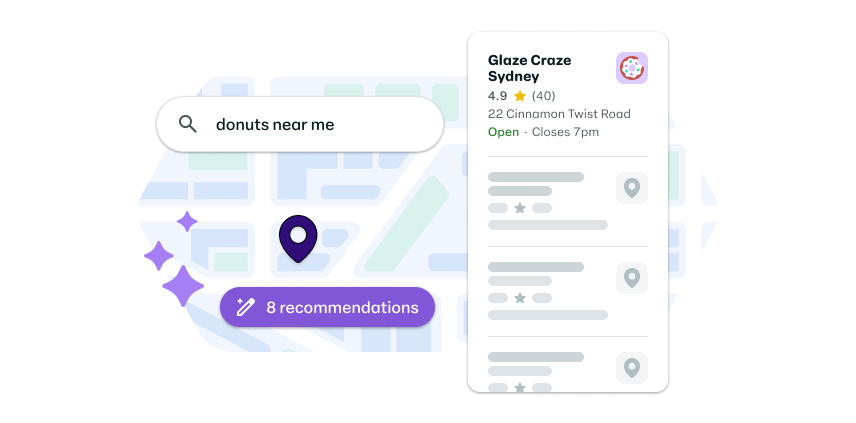
On 12 March 2026, Google replaced the Q&A feature in Google Maps with Ask Maps, a Gemini-powered conversational AI that answers natural-language queries directly inside the Maps interface.
When someone opens Google Maps and types “best real estate agent in Mosman,” they no longer receive a ranked list of profiles to scroll through. Instead, they receive a single synthesised recommendation, generated by an AI drawing on hundreds of millions of places and community reviews.
The implication for multi-location businesses is structural. Visibility used to be a function of profile completeness, claim your listing, fill in your hours, add some photos, and you would appear. Ask Maps rewards something different, recency, review quality, photo freshness, attribute accuracy, and consistency across all your locations.
A franchise network where head office looks pristine but individual offices are stale, under-reviewed, or inconsistently named is now a network with gaps in its AI recommendation layer. Those gaps are invisible until a competitor fills them, which is especially problematic for franchise networks with independently operated offices. These can begin to resemble “ghost offices” to an AI recommendation engine.
The takeaway: content needs to orient toward a 70/30 model, 70% location-specific and 30% brand-level.
2. Apple Business launched on 14 April, your listing data migrated whether it was ready or not
On 24 March, Apple announced that Apple Business Connect, Apple Business Manager, and Apple Business Essentials would merge into a single free platform called Apple Business, launching on 14 April 2026.
For most businesses, the transition was quiet, existing location data migrated automatically, accounts carried over, and the new interface went live without fanfare.
The risk is precisely that quietness. Automatic migration means accurate data migrated accurately, and inaccurate data migrated as-is.
Any location with:
- an incorrect address
- outdated trading hours
- a missing phone number
- or an unclaimed listing
now has those issues embedded in a platform that will serve as Apple’s local discovery infrastructure going forward.
Apple has also previewed paid advertising in Apple Maps launching in the US and Canada this summer, with broader rollout expected. Networks with clean, verified listings will be better positioned to take advantage of this. Those that didn’t audit before the migration will be playing catch-up.
3. Bing Places now feeds ChatGPT and most Australian brands haven’t noticed
In February 2026, Microsoft confirmed that Bing Places for Business is a primary data source feeding local results in Microsoft Copilot, ChatGPT via Bing integration, and Windows Search.
This matters because of how these products are being used. When someone asks a Copilot assistant, “where is the nearest mortgage broker” or “which real estate agency covers [suburb],” the answer comes from Bing Places, not Google.
Businesses with incomplete or unclaimed Bing profiles are not ranked lower, they are excluded entirely.
For Australian brands whose digital marketing has been built almost entirely around Google, this is a blind spot that is growing quietly.
Bing’s share of direct search may be modest, but its role as the data backbone for AI assistants gives it reach well beyond its own search volume.
Microsoft also launched an AI Performance dashboard in Bing Webmaster Tools in February, the first tool that lets businesses directly measure how their content is cited in AI-generated answers. It’s worth checking.
4. Recency now beats history in local rankings
A consistent theme across 2026 local SEO research is the growing dominance of recency signals.
Google now weights activity in the last 90 days, new reviews earned, posts published, photos uploaded, and review responses written, far more heavily than the accumulated completeness of a profile built up over years.
A business that was meticulous about its Google Business Profile in 2023 but has been quiet since is actively losing ground to a competitor that has been consistently active over the last three months, even if that competitor’s profile is less “complete” by traditional measures.
For multi-location networks, this creates a compounding problem.
Individual offices that went quiet during leaner periods, or that were never properly managed in the first place, are dragging down the network’s overall visibility in their local catchments.
An increasing number of consumers are now using generative AI for local business recommendations, and those answers are increasingly shaped by recency signals.
The solution isn’t a one-time cleanup. It’s consistent, location-level activity at scale.
5. What a Snapshot Audit actually shows you
The platforms selling “agentic AI” presence management, SOCi, Birdeye, and their competitors, are making a coherent pitch. Let autonomous agents manage your listings, reviews, and competitive monitoring without manual input.
It’s a compelling story, particularly for enterprise brands managing hundreds of locations.
But what if you could do all of that while retaining visibility into what’s actually happening behind the scenes?
This is what marketing and operations teams still need, and it starts with seeing their own data.
A Snapshot Audit pulls together the health of every location across Google, Apple Maps, Bing, and Facebook into a single view:
- listing accuracy scores
- review ratings by office
- photo gaps
- hours inconsistencies
- competitor performance in the same catchments
Not just a promise about what AI could do, but a clear picture of what’s happening right now, at specific locations, that the business may not have seen before, and visibility as AI agents and tools get to work.
This is what consistent, location-level presence management actually looks like in practice.
The window is now
The changes that landed in March and April 2026 are not temporary adjustments.
Ask Maps, Apple Business, Bing’s role in AI assistants, and the recency weighting in local rankings represent the new infrastructure for local discovery.
The networks that audit their presence now, before gaps compound and competitors establish dominance in the AI recommendation layer, will have a structural advantage that is very difficult to recover once lost.
See where your network stands
If you want to understand how your locations are performing across Google, Apple, and Bing today:
👉 Run your free Snapshot Audit


